

PVC Shower Chairs: A Practical Guide to Choosing the Right Chair
PVC Shower Chairs: A Practical Guide to Choosing the Right Chair
Bathing can become difficult or unsafe when a person has limited balance, strength, or mobility. A properly selected PVC shower chair can make bathing safer, more comfortable, and easier for both the user and caregiver.
But not every PVC shower chair is the same. Seat size, chair height, arm style, casters, footrests, toilet clearance, and weight capacity can all determine whether a chair works well in a particular bathroom.
Before purchasing, here are the most important things to consider.
What Is a PVC Shower Chair?
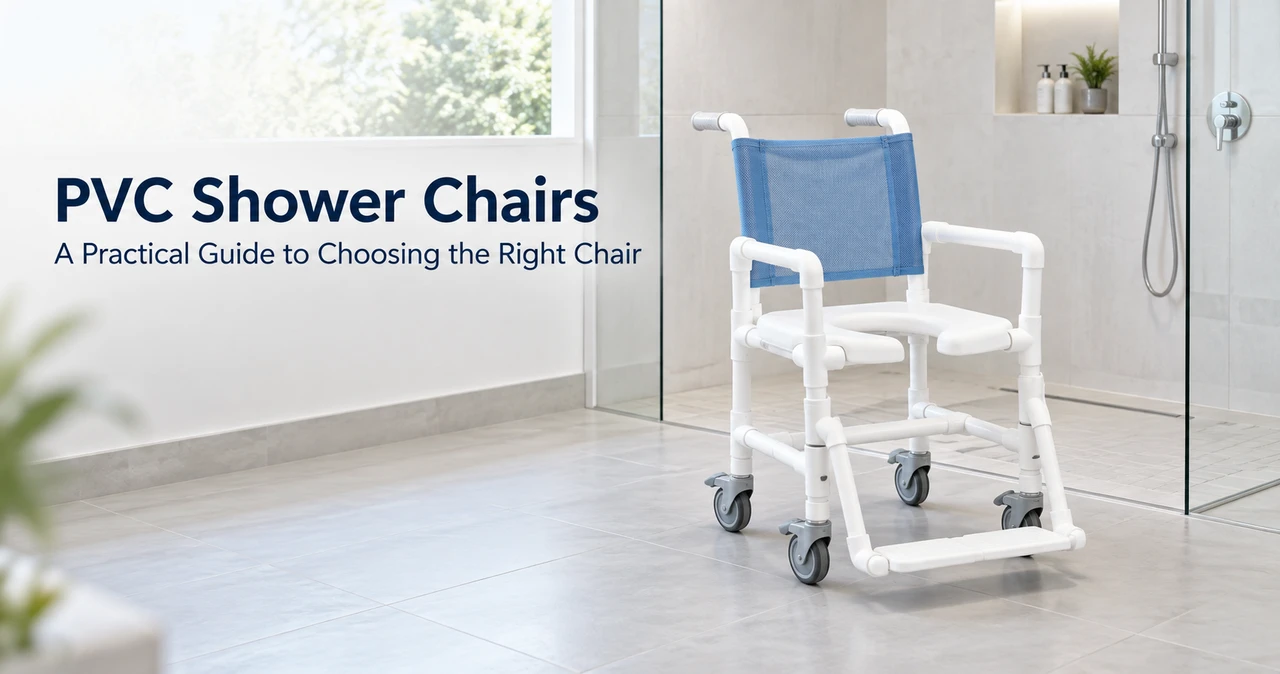
A PVC shower chair is a bathing chair built with a healthcare-grade PVC frame. Many models have casters, allowing a caregiver to roll the user into a wheelchair-accessible or zero-threshold shower. Commode-style models may also roll over a toilet or be used with a removable pail.
PVC is well suited for wet environments because it will not rust like untreated metal. It is also easy to clean and generally comfortable to the touch. Most healthcare-grade chairs reinforce the frame at stress points and use fast-drying mesh or water-resistant seating materials.
PVC shower chairs are used in private homes, assisted-living communities, nursing facilities, hospitals, rehabilitation settings, and group homes.
Why Choose a PVC Shower Chair?
The right PVC chair can provide several practical advantages:
-
Rust-resistant frame: PVC is a good choice for bathrooms and other wet environments.
-
Easy cleaning: Smooth frame surfaces and removable components can simplify routine cleaning.
-
Comfort: PVC does not have the cold feel of a bare metal frame, and many chairs offer mesh backs or padded seats.
-
Multiple configurations: Models are available with open-front seats, soft seats, commode pails, footrests, swing-away arms, and different weight capacities.
-
Caregiver convenience: Rolling models can reduce the number of transfers required during bathing and toileting.
These benefits do not automatically make every model right for every user. Accurate measurements and a clear understanding of how the chair will be used are essential.
1. Measure the User and the Bathroom
Start with both the person and the space. Measure the user's seated hip width and allow enough room for comfort without choosing a chair that is unnecessarily wide.
Next, measure:
-
The narrowest doorway the chair must pass through
-
The shower entrance
-
The usable interior space of the shower
-
The height and shape of the toilet, if the chair will roll over it
-
The space available for turning and caregiver access
Pay attention to both the internal seat width and the overall outside width. A chair may fit the user but still be too wide for the bathroom doorway.
2. Choose the Correct Seat Height
Seat height is one of the most important—and most frequently overlooked—measurements.
If the user transfers from a wheelchair or bed, a similar seat height can make transfers easier. This is especially important when using a transfer board, since a relatively level transfer is generally easier than moving sharply upward or downward.
If the chair will roll over a toilet, check the chair's toilet-clearance height, not just its seat height. Measure the toilet with its existing seat raised and confirm that the chair frame and seat opening will clear the bowl.
Whenever possible, compare the new chair with a wheelchair or chair height the user already finds comfortable.
3. Decide Between Fixed, Drop, or Swing-Away Arms
Arm style affects both support and transfers.
-
Fixed arms provide a stable surface for users who can stand, pivot, or lower themselves into the chair.
-
Drop arms or swing-away arms create a more open side for lateral transfers from a wheelchair or bed.
-
Dual swing-away arms may provide additional flexibility when the transfer direction changes or caregivers need access from either side.
The best choice depends on the user's transfer method. If you are uncertain, discuss the transfer process with the user's occupational therapist, physical therapist, or other qualified healthcare professional.
4. Select the Right Seat Style
PVC shower chairs are available with several seat types:
-
Open-front seats improve access for personal hygiene.
-
Commode seats can be positioned over a toilet or used with a compatible pail.
-
Soft seats add cushioning for people who need greater comfort or who remain seated for longer periods.
-
Solid or mesh seating components may be preferred depending on support, drainage, and cleaning needs.
Comfort matters, but so do positioning and skin protection. A healthcare professional should help evaluate seating for anyone with reduced sensation, a history of pressure injuries, significant postural needs, or an inability to reposition independently.
5. Consider Footrests and Leg Support
A footrest can keep the user's feet supported while the chair is moving. Depending on the model, the footrest may slide away, fold, or be removed to provide more space for standing and transfers.
Never allow a user to stand on a footrest unless the manufacturer specifically states that it is designed for that purpose. Before each transfer, position the chair, arms, and footrest according to the manufacturer's instructions.
6. Check Casters and Locks
Casters affect how easily a rolling shower chair travels across bathroom flooring and thresholds. Larger casters may handle small transitions more easily, while compact casters can help keep the chair's overall height lower.
Confirm:
-
The caster size
-
Which casters lock
-
Whether the locks are easy for the caregiver to reach
-
Whether the chair can cross the bathroom's actual threshold or floor transition
-
Whether there is enough space to turn the chair safely
Locks should be engaged as directed by the manufacturer during transfers and whenever the chair must remain stationary.
7. Verify the Weight Capacity
Never select a chair solely by its appearance or seat width. Check the manufacturer's stated weight capacity and choose a chair appropriate for the user's current needs.
Standard PVC shower chairs commonly support many adult users, while bariatric models are available with wider seats, reinforced frames, heavy-duty casters, and substantially higher capacities. CareProdx offers models ranging from pediatric and standard chairs to heavy-duty rolling shower chairs with capacities up to 900 pounds.
A higher weight rating does not necessarily mean a chair will fit through the bathroom door, clear the toilet, or provide the correct seat dimensions. Every measurement still matters.
8. Think Through the Entire Bathing Routine
Picture the full trip, not just the time spent inside the shower:
-
Where will the user transfer into the chair?
-
Can the chair pass through every doorway?
-
Is the shower entrance level, or is there a curb or threshold?
-
Can a caregiver maneuver around the chair?
-
Will the chair also be used over a toilet?
-
Where will the wet chair be cleaned, dried, and stored?
A rolling shower chair usually works best with a properly sized, wheelchair-accessible shower. It is not intended to be rolled over the wall of a conventional tub.
PVC Shower Chair Buying Checklist
Before ordering, confirm all of the following:
-
User's seated hip width
-
Required seat width and depth
-
Preferred seat height
-
Overall chair width
-
Narrowest doorway width
-
Shower-entry width and threshold height
-
Toilet height and required clearance
-
Transfer method
-
Arm style
-
Seat style
-
Footrest needs
-
Caster size and locking configuration
-
Weight capacity
-
Caregiver access and storage space
Let CareProdx Help You Choose
CareProdx offers healthcare-grade PVC shower chairs for a wide range of users and care settings, including basic rolling chairs, soft-seat models, commode chairs, swing-away-arm chairs, pediatric chairs, and bariatric models.
The measurements can be confusing, and choosing incorrectly may leave you with a chair that does not fit the user, bathroom, shower, or toilet. If you are unsure, call CareProdx at 800-413-3302 before ordering. Our team can help you compare the important dimensions and available features so you can make a more confident choice.
This article provides general product-selection information and is not medical advice. Consult an appropriate healthcare professional for help assessing transfers, positioning, pressure management, or an individual's clinical needs.
Latest News

Tax Breaks for ADA Commercial Door Openers: What Business Owners Should Know
Tax Breaks for ADA Commercial Door Openers: What Business Owners Should Know Adding an automatic doo...

HOW TO MAKE YOUR SHOWER HANDICAP ACCESSIBLE
Aging in place or accommodating mobility challenges doesn't mean sacrificing comfort or independence...

How Much Does an ADA Automatic Door Opener Cost? Equipment, Installation and Options Explained.
$3200 will cover the cost of equipment and labor for a basic door operator with two wall mounted but...
PVC Shower Chairs: A Practical Guide to Choosing the Right Chair
PVC Shower Chairs: A Practical Guide to Choosing the Right Chair Bathing can become difficult or un...

Walk-In Tub vs. Wheelchair Accessible Shower: Which Is Right for Your Bathroom?
Short answer: if there is a good chance the person will ever use a wheelchair or rolling shower chai...
Wheelchair Accessible Showers: What to Look For Before You Buy or Remodel
If you're planning a bathroom for someone who uses a wheelchair — a parent, a spouse, yourself — the...