

Walk-In Tub vs. Wheelchair Accessible Shower: Which Is Right for Your Bathroom?
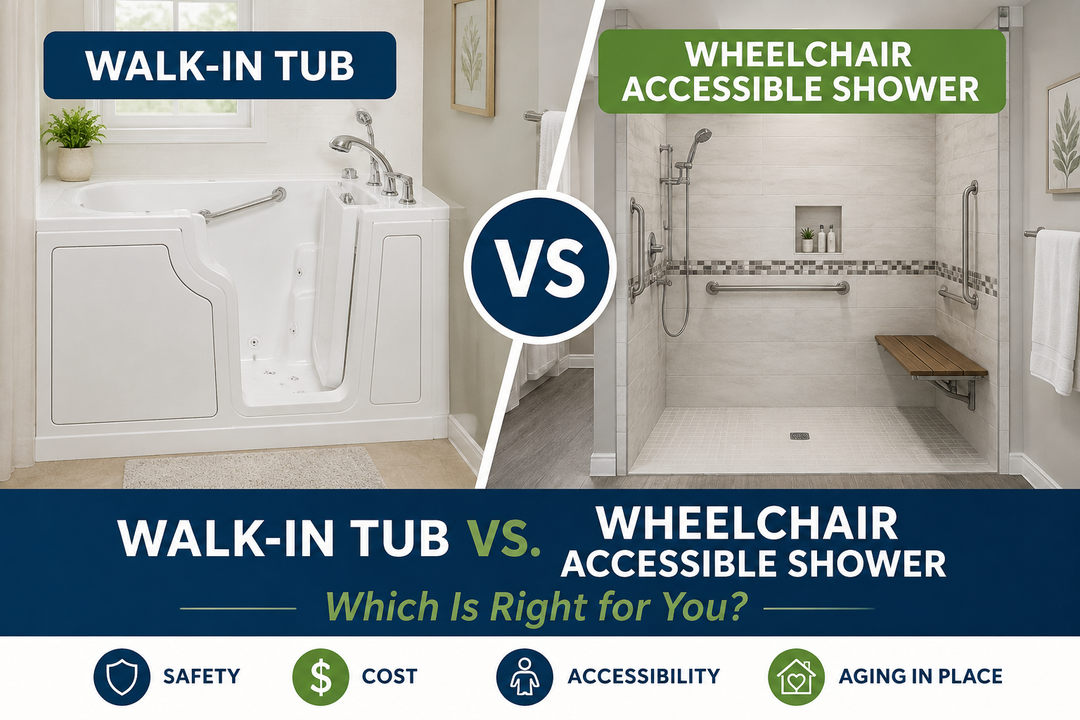
Short answer: if there is a good chance the person will ever use a wheelchair or rolling shower chair — now or down the road — a roll-in or wheelchair accessible shower is almost always the better long-term choice. A walk-in tub can work well for someone who can step over a low threshold and sit unassisted, but it becomes a barrier the moment mobility declines further. Below is the full breakdown so you can match the choice to the actual person, not just the marketing photos.
The Core Difference
A walk-in tub is a soaking tub with a watertight door built into the side. You step in, sit down, close the door, and then fill and drain the tub around you. A wheelchair accessible shower — roll-in or transfer-type — has no basin to fill at all; water drains continuously through a sloped pan, so there's no waiting to get in or out.
That single difference — "sit inside a basin that fills and drains" versus "stand or roll through a draining pan" — is what drives almost every other tradeoff below. Imagine getting your walk in tub filled and then needing to use the toilet. It's not a simple process.
Comparison at a Glance
| Factor | Walk-In Tub | Accessible Shower |
|---|---|---|
| Works for wheelchair/rolling chair users | No — must be able to step over the threshold and transfer into a seated tub | Yes — roll-in models have zero threshold |
| Time to use | 6–20 min to fill, 10–15 min to drain — you're sitting wet and cold while it empties | Immediate — water drains continuously, in and out whenever |
| Typical cost (unit + install) | $3,000–$10,000+, often more with plumbing changes for fast-fill/drain | $2,000–$8,000+ depending on pan size and whether it's a retrofit |
| Best for | Someone who can step in/transfer independently and wants a soaking bath, arthritis/joint relief | Anyone using a wheelchair or shower chair, or whose mobility is expected to decline |
| Bathroom footprint | Similar to a standard tub; less floor clearance needed | Roll-in works in a standard bathtub footprint (ADA minimum 30″ x 60″) but deeper than 30" is better to maneuver a chair |
| Caregiver assistance | Harder — caregiver can't easily reach in-swing door or wait through fill/drain cycles | Easier — open access, caregiver can assist throughout. See our caregiver shower curtains for more details. |
| Resale/property value | Mixed — some buyers see it as a specialty fixture | Generally neutral to positive — reads as a modern, low-threshold shower. Our roll in showers are also available with a temporary "standard" threshold that can be added and removed as necessary. Click here to see the temporary threshold. |
Where a Walk-In Tub Still Makes Sense
- The person can step over a 3–7″ threshold safely and sit down unassisted or with minimal help
- Soaking for arthritis, circulation, or joint pain is a priority, not just getting clean
- There's no expectation of needing a wheelchair or rolling shower chair in the foreseeable future
- A hydrotherapy/jetted model is wanted specifically for pain management, on a doctor's or PT's recommendation
If none of those apply, the fill/drain wait time and the step-over threshold are real risks, not minor inconveniences — see our full rundown of walk-in tub drawbacks before buying one.
Where an Accessible Shower Wins
- The person currently uses, or is likely to eventually need, a wheelchair or rolling shower chair
- Independence matters — no waiting on a fill/drain cycle, no door to unlock before getting out
- A caregiver needs to be able to assist throughout the shower, not just at the start
- You want one remodel to last through changing mobility instead of remodeling again later
This is the more future-proof option in most cases. If you're not sure it'll actually function the way it looks in photos, our guide to what makes a shower truly wheelchair accessible covers the dimensions, seating, and water-containment details that get overlooked.
What About Doing Both?
Some households keep both walk-in tub for soaking and a separate accessible shower for daily use. That works when there's a caregiver or spouse who also uses the tub, or when bathroom space and budget allow for two fixtures. For a single-user bathroom being remodeled for one person's accessibility needs, most of our customers end up standing by one choice rather than two — it's simpler, cheaper, and easier to maintain.
Frequently Asked Questions
Can a walk-in tub be converted to a roll-in shower later?
Not without a full re-demolition. A walk-in tub's basin and door are built for a fill-and-drain cycle, not a continuously sloped drain pan, so a real conversion means tearing out the tub and starting the plumbing and flooring over. If there's any chance of needing wheelchair access later, it's cheaper to install the accessible shower now.
Is a walk-in tub or accessible shower better for a caregiver who has to help every time?
An accessible shower. Open, continuous access lets a caregiver help someone in, stay through the shower, and help them out without ever waiting on a fill or drain cycle or working around an in-swing tub door.
Which one costs less to install?
It depends on the home more than the fixture. A walk-in tub dropped into an existing tub's footprint can be cheaper if no plumbing moves. A roll-in shower can cost more depending on the size desired, but it's often cheaper than a walk-in tub once you add a fast-fill/fast-drain pump, which most people end up wanting anyway.
Does Medicare or insurance cover either option?
Original Medicare generally doesn't cover either as a home modification. Some Medicare Advantage plans, VA benefits, and long-term care insurance policies do cover part of the cost — it's worth checking your specific plan before budgeting either option in.
Still Not Sure Which Fits Your Situation?
Call us at CareProdx at 800-413-3302 and describe the bathroom and the person using it. We field this exact question every week, and most of the time the right answer becomes obvious once we know how someone actually transfers and what their mobility looks like six months or a year from now — not just today.
Latest News

How Much Does an ADA Automatic Door Opener Cost? Equipment, Installation and Options Explained.
$3200 will cover the cost of equipment and labor for a basic door operator with two wall mounted but...
PVC Shower Chairs: A Practical Guide to Choosing the Right Chair
PVC Shower Chairs: A Practical Guide to Choosing the Right Chair Bathing can become difficult or un...
Walk-In Tub vs. Wheelchair Accessible Shower: Which Is Right for Your Bathroom?
Short answer: if there is a good chance the person will ever use a wheelchair or rolling shower chai...
Wheelchair Accessible Showers: What to Look For Before You Buy or Remodel
If you're planning a bathroom for someone who uses a wheelchair — a parent, a spouse, yourself — the...

How Often Should Seniors Shower
If you're caring for an aging parent or loved one, you may have noticed they resist their daily show...

Do ADA Requirements Apply To Churches?
Federal ADA requirements generally do NOT apply to churches and other religious organizations. Churc...