

Tax Breaks for ADA Commercial Door Openers: What Business Owners Should Know
Tax Breaks for ADA Commercial Door Openers: What Business Owners Should Know
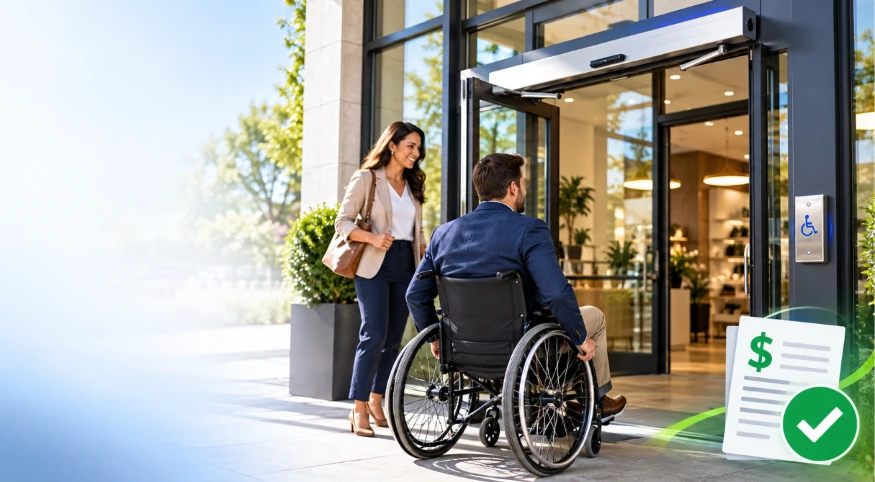
Adding an automatic door opener to a storefront, office, or clinic does more than make the entrance accessible. It can also lower your federal tax bill. Two provisions of the Internal Revenue Code help offset the cost of accessibility improvements: the disabled access credit under Section 44 and the barrier removal deduction under Section 190.
This guide explains both, what kinds of work qualify, and where to be careful. It is general information, not tax advice. Talk to your CPA before you file.
The disabled access credit (IRC Section 44)
The credit is designed for small businesses. To qualify, a business must have either $1 million or less in gross receipts for the prior year, or no more than 30 full-time employees. Full-time means at least 30 hours a week for 20 or more weeks in the tax year.
The credit equals 50 percent of eligible access expenses that fall between $250 and $10,250 in a tax year. The most you can claim is $5,000 per year. For example, if you spend $6,000 on eligible work, the credit is 50 percent of $5,750, or about $2,875.
To claim it, file IRS Form 8826. The credit applies to expenses that make your business accessible and that go beyond what the ADA alone requires for your building. Check the current Form 8826 instructions for the exact rules.
The barrier removal deduction (IRC Section 190)
Section 190 lets any business, regardless of size, deduct up to $15,000 per year for the cost of removing architectural and transportation barriers for people with disabilities and the elderly. Costs above the limit are not lost. They can be added to the property's basis and depreciated over time.
Automatic door openers are a common example of qualifying work, since they remove a barrier at the building entrance.
Can you use both?
Possibly, but the answer depends on the rules for your situation, and IRS publications do not all agree on how the two provisions interact in the same year. In general, the Section 44 credit reduces the amount of expense you can deduct under Section 190, so you cannot count the same dollars twice. Your CPA can tell you which combination gives you the best result.
What usually qualifies
- Automatic or power-assist door openers, installed at accessible entrances
- Door hardware changes, such as lever handles and lower-force hardware
- Ramps, curb cuts, and accessible parking improvements
- Installation labor, wiring, and related materials for the above
Routine repairs and maintenance generally do not qualify as barrier removal. Keep your invoices and product specs, because the IRS can ask you to show what each dollar paid for.
Next steps
- Confirm whether your business meets the Section 44 size test.
- Get itemized quotes that separate accessibility work from other building upgrades.
- Save the invoices and product documentation.
- Share the plan with your tax advisor before the work starts, not after.
Not sure which door opener your building needs? CareProdx sells commercial ADA door openers and can help you match the product to your entrance. Call us at 800-413-3302.
Be sure to confirm all this with your accountant and discuss how much you might be spending to complete the work. Again, we can help you with cost estimates. Call us at 800-413-3302.
Latest News

Tax Breaks for ADA Commercial Door Openers: What Business Owners Should Know
Tax Breaks for ADA Commercial Door Openers: What Business Owners Should Know Adding an automatic doo...

HOW TO MAKE YOUR SHOWER HANDICAP ACCESSIBLE
Aging in place or accommodating mobility challenges doesn't mean sacrificing comfort or independence...

How Much Does an ADA Automatic Door Opener Cost? Equipment, Installation and Options Explained.
$3200 will cover the cost of equipment and labor for a basic door operator with two wall mounted but...
PVC Shower Chairs: A Practical Guide to Choosing the Right Chair
PVC Shower Chairs: A Practical Guide to Choosing the Right Chair Bathing can become difficult or un...
Walk-In Tub vs. Wheelchair Accessible Shower: Which Is Right for Your Bathroom?
Short answer: if there is a good chance the person will ever use a wheelchair or rolling shower chai...
Wheelchair Accessible Showers: What to Look For Before You Buy or Remodel
If you're planning a bathroom for someone who uses a wheelchair — a parent, a spouse, yourself — the...